

Your competitor just installed smart shopping carts. You probably haven’t noticed yet, but your customers have, and they might soon bounce. But let’s suppose none of your competitors have adopted smart shopping carts. If that’s true, consider that your sign to be the first to adopt them because early adopters are seeing measurable advantages in throughput, labor costs, and customer retention.
If you procrastinate now, you’ll spend the next few years trying to win back customers who’ve grown accustomed to a better experience elsewhere. But what are smart shopping carts in the first place? If you’re wondering about that, don’t worry. This article discusses everything about smart shopping carts. You’ll learn what they are, why you should adopt them, their benefits, features, and where to obtain them.
So start reading.
What Are Smart Shopping Carts? (And How They Work in 2026)

Smart shopping carts are exactly what they sound like.
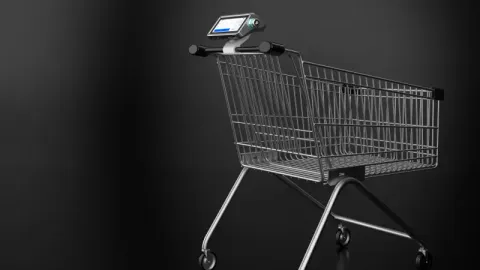
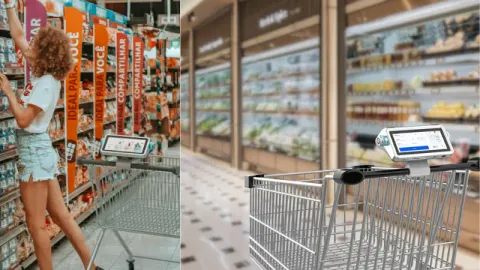
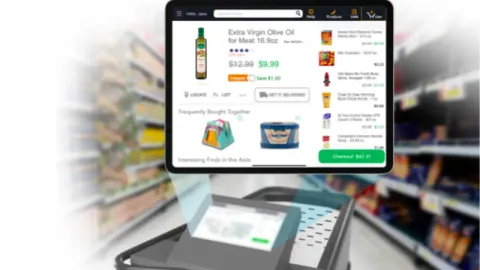
In looks, they’re almost like traditional shopping carts but with a screen mounted near the handle, along with cameras, sensors, or weight scales built into the basket itself.
Before placing items inside a smart cart, customers just need to scan them through the barcode scanner or cameras. For items that don’t come with pricing information, like vegetables, they can use the weight scale to get the price.
The running total appears on the screen and updates with each addition or removal.
These carts are synced with the point-of-sale systems of the store, so they’re always pulling the same pricing data that the registers use.
Once customers are done shopping, they can pay right there on the cart’s screen. Quick contactless checkout. No hassle of waiting in line.
But there’s more. Smart shopping carts can also integrate with the loyalty system of the store. They can recognize loyal customers when they scan their loyalty card or app at the beginning of the trip. The cart then suggests products based on their purchase history, informs them about personalized deals, or automatically applies discounts they’ve earned.
So in short, smart shopping carts are a lot different from traditional ones. They solve friction points for both shoppers and store staff.
Why Retailers Are Adopting Smart Carts in 2026: Market Drivers
Retailers are turning to smart shopping carts because the old way of doing things has become unsustainable.
Here are the main drivers of this change.
Labor Shortages And Rising Wage Costs
Staffing a store has never been more expensive or more difficult than it is now.
According to the U.S. Bureau of Labor Statistics, wages have climbed steadily. Its monthly Employment Situation report found that average hourly earnings jumped 3.8% in the year leading to September 2025.
That might sound modest until you multiply it across an entire workforce.
Meanwhile, the Workplace Journal had also foretold about retail job cuts through 2025 due to these rising labor costs and disappointing sales figures. The math just doesn’t work anymore.
So instead of hiring multiple cashiers and adding to the payroll, smart carts for retailers are a more feasible option.
Long Queues Hurting Customer Satisfaction
Consumer patience has also left the building by now.
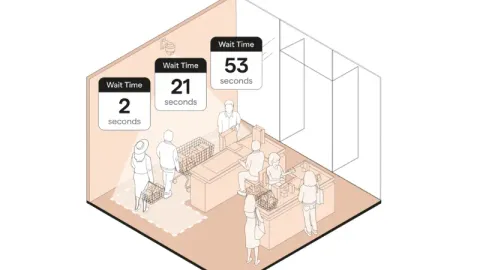
In 2023, a survey of retail store CCTV footage revealed that 73% of shoppers simply abandon their purchase if they’re stuck waiting more than five minutes to check out. Five minutes. That’s barely enough time to scroll through a few social media reels.
But waiting in lines isn’t as fun as that, which explains how five minutes can become the breaking point between a completed sale and an abandoned cart.
And long queues aren’t only annoying for customers. They also hemorrhage a store’s revenue.
Smart cart solutions for retail eliminate that chokepoint entirely. That’s yet another boosting point of the smart cart ROI.
Need For Ai Automation In Retail
AI retail hardware trends also play a role in the widespread adoption of smart shopping carts.
The global artificial intelligence in the retail market stood at $11.61 billion in 2024 and is projected to balloon to $40.74 billion by 2030.
That kind of growth shows that AI genuinely solves problems at scale.
Some smart shopping carts use computer vision and machine learning to recognize products and personalize the shopping experience in ways that would require an army of human assistants.
And the use of AI in these carts is only going to increase. So expect an even more rapid adoption of smart retail technology in 2026.
Growth of Contactless Checkout Demand
The pandemic accelerated something that was already brewing. Most people do not prefer touching payment terminals that thousands of others have used.
They also wish to checkout without having to contact a cashier. And that makes sense. Most of us wouldn’t want people to perceive us based on what we have bought, especially when it comes to items that cause embarrassment.
A report shows that 73% of millennials and 66% of Gen Z now prefer contactless payment methods.
Smart carts deliver on this expectation naturally.
The Top Benefits of Smart Shopping Carts for Retailers
Let’s cut through the marketing speak and talk about how smart shopping carts improve daily operations and your bottom line.
Faster, Queue-Free Shopping Experiences
The checkout line has always been retail’s Achilles heel. It’s where you can still lose the sale you’ve already won.
But with smart shopping carts, you can get rid of that revenue sucking vulnerability. Customers load items, pay on the cart itself, and leave.
When customers don’t have to wait for a cashier to finish with the person ahead, there won’t be any last-second decision to put everything back because the line’s too long.
Each smart cart essentially becomes its own express lane. In other words, each smart cart is a cashier.
Higher Customer Throughput During Peak Hours
Smart carts also cut the need to overstaff for peak hours every now and then.
With them, you can handle drastically more shoppers during times like that Saturday morning surge or after-work rush.
In the meantime, your actual staff can focus on stocking, customer service, or the hundred other tasks that get neglected when everyone’s stuck running registers.
Increased AOV Through Personalized Upsells

Smart carts not only boost revenue by catering to more customers. They also increase your chances of upselling to them.
The smart cart knows what’s in the basket and can suggest complementary items at exactly the right moment.
If someone has grabbed noodles, they might also need pasta sauce. Customers also commonly forget to buy batteries with a toy.
Smart carts for retailers never get tired or forget to mention such a promotion.
Real-Time Inventory Accuracy
Smart carts redefine how fast real-time can be.
The moment an item goes into a cart, not when it reaches checkout ten minutes later, your system knows.
Your staff can restock out-of-stock items even more quickly, so no customer goes back empty-handed.
Reduced Human Errors And Fewer Manual Processes
It’s no secret that manual processes breed loads of mistakes.
There can be miskeyed produce codes, missed scans, pricing disputes at checkout, and whatnot.
Smart carts automate the entire capture process, and machines don’t have off days.
The consistency alone improves your shrink numbers, but there’s also the reduction in customer friction when prices are always accurate, and nothing gets charged twice.
Your staff stops spending time fixing transaction errors and resolving complaints about incorrect totals. The time savings compound across every shift.
Improved Customer Satisfaction And Loyalty
In most places, customer satisfaction is this nebulous thing you’d measure through surveys and hope it was trending upward.
But with smart shopping carts, customer satisfaction comes built in.
Shoppers remember the stores where shopping feels effortless, where they don’t waste time in lines, and where they discover products they actually want.
That convenience alone makes customers visit repeatedly. And your ability to retain customers hit the roof.
Smart Cart ROI: Why the Investment Pays Off
Does investing in smart shopping carts actually return more than it costs? The answer, increasingly, is yes.
Here’s a detailed answer.
Labor Cost Reduction
One of the largest expenses of a retail store is labor. We also discussed how it’s growing fast.
Smart carts don’t replace your entire workforce. You still need staff for customer service, merchandising, stocking, and specialty departments, but they do let you run leaner at the front end.
For instance, instead of scheduling six cashiers for Saturday afternoon, you need two to handle exceptions and assist customers.
Shorter Queues Increase Store Capacity
Smart carts also let you serve more customers using the same physical footprint. Your store’s throughput isn’t constrained by checkout lane count anymore.
During peak periods, you’re no longer turning away business because queues are snaking down the aisles. You can effectively increase your store’s capacity by 20-30% without laying a single new brick or expanding your square footage.
This also saves retailers from having to rent more space.
Reduced Cart Abandonment
We talked earlier about 73% of shoppers who’ll bail if the wait exceeds five minutes.
Every one of those abandoned carts represents lost revenue that was already in hand.
Smart carts recover these losses directly. It’s found money. You’re suddenly able to reclaim the revenue you were leaving on the table simply because your checkout process couldn’t keep pace with shopping speed.
Higher Basket Sizes With AI-Driven Recommendations
You read earlier how smart shopping carts allow retailers to upsell to customers.
With AI-driven recommendations embedded in smart carts, basket size increases.
And you won’t have to spend more on marketing or promotions to land these upsells. The cart does the work automatically by suggesting relevant products at precisely the moment of peak receptivity.
Lower Operational Costs Compared To Building New Self-Checkout Lanes
You might think to build more self-checkout lanes to tackle the issues that smart shopping carts tackle.
But does that have a profitable ROI? The answer is NO!
Consider the expenses of building new lanes:
- Construction
- Additional POS terminals
- More space
- Maintenance
- More staff
By comparison, smart shopping carts cost much less.
You don’t need to invest in new checkout lanes, and you avoid the day-to-day issues that come with running them.
The return on investment is even better when you consider what smart carts can do. They track inventory, support personalized shopping, and provide useful data insights—features that traditional self-checkout machines simply don’t offer.
Smart Carts vs Other Retail Technologies (Self-Checkout, SCO, Mobile Scan)
You’ve probably already invested in some form of checkout solutions.
Where do smart carts fit, and are they actually better than what you’re already running?
Smart Carts Vs Self-Checkout Lanes
Self-checkout seemed like the answer a decade ago, and it solved part of the problem. But walk through your store during rush hour and watch what actually happens.
Customers bunch up at the SCO area, waiting for a free terminal. Someone inevitably struggles with the product codes or triggers the weight sensor error. Your staff member stationed there spends their entire shift troubleshooting and approving age-restricted items.
Smart carts sidestep this entire circus by distributing checkout throughout the shopping journey itself. Customers finish shopping and simply leave.
The throughput difference is dramatic. You’re processing purchases continuously rather than funneling everyone through a fixed set of terminals.
Smart Carts Vs Mobile Scanning Apps
Mobile scan-and-go apps have adoption problems. Most shoppers never download the app in the first place, and those who do often forget to use it or find the experience clunky.
Smart carts embed the same functionality into carts that customers are bound to use. You don’t need to take extra measures for onboarding them.
Plus, you avoid the random audit friction that comes with mobile apps, where customers get stopped for verification checks that undermine the whole convenience promise.
Key Features Retailers Should Look for When Selecting a Smart Cart Solution
Even when looking for smart cart solutions, you need to avoid making the wrong choice that will haunt you for years through maintenance headaches and disappointed customers.
- AI-powered recognition: Look for solutions using computer vision and weight sensing in combination. This redundancy catches errors and handles tricky items like produce or bulk goods that don’t have barcodes. The AI should also get better at distinguishing between similar items over time.
- Rugged hardware quality: These carts will get banged into curbs, left in rain, operated by customers who don’t treat them gently, and used continuously for years. So check the build quality obsessively. Evaluate the following, especially:
- Are the screens protected?
- Can the system handle temperature extremes if you have outdoor cart corrals?
- How does it hold up when the battery compartment gets wet?
- Long battery life: Systems should run a full day on a single charge, ideally longer. Also, check if the carts charge while nested together in corrals, or do they need individual docking stations?
- Real-time connectivity: Smart carts need a stable connection to your systems to keep prices updated, track inventory, and process payments. Check whether the provider includes network upgrades in their solution, or if you’ll need to handle connectivity yourself.
- Modular components: A modular cart is easier and cheaper to maintain over time. You should be able to replace parts like screens or cameras when they wear out—without replacing the entire cart.
- Scalability and analytics: You should be able to start small (for example, 20 carts) and scale up to hundreds without rebuilding your system. The platform should also show clear data—how customers move through the store, which promotions work, and where shoppers spend the most time.
Future Trends: What Smart Retail Technology Looks Like Beyond 2026
The future’s smart retail solutions will make today’s technology look quaint by comparison.
Here’s where the industry is likely headed in the future:
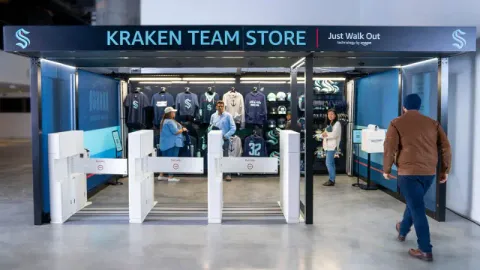
- AI-powered autonomous stores: Amazon has been testing a technology called Just Walk Out for some time. With this technology, there is no checkout process in stores at all. Cameras and sensors track what you take, your account gets charged automatically, and you simply walk out. Many businesses have already adopted Just Walk Out, and their testimonies are available on Amazon’s website.
- Dynamic pricing carts: Your cart might soon adjust prices in real-time based on different factors. Milk approaching its sell-by date? The cart offers you a discount the moment you pick it up. Loyal customer who buys premium products? You see different promotions than the bargain hunter next to you.
- More scalable frictionless checkout: The current generation of smart carts still requires some customer action. Next-generation systems will make even these minimal steps unnecessary. You’ll just toss items in naturally while shopping, and the cart handles everything invisibly.
- Integration with robotics and shelf sensors: Smart carts will talk to robots roaming the aisles and sensors embedded in shelves. A cart detects you’re searching for an out-of-stock item and dispatches a robot to bring one from the back. Shelf sensors notice products running low and trigger automatic reordering before you ever face an empty spot. These and many unimaginable things are going to get real sooner than you think.
Smart Shopping Carts Are Now a Strategic Investment, Not a Trend
Not long ago, the shopping cart got its biggest upgrade since someone added wheels and a basket.
And loads of retailers have already adopted the technology. If you haven’t made the same move yet, now is your time. Because soon, smart carts will become standard equipment in the same way self-checkout did.
The ROI of smart shopping carts is increasingly undeniable. So the question of whether smart carts make sense should be out of the window.
The only thing you should be figuring out is how to get them.
Take the Next Step With SwiftForce
SwiftForce helps retailers turn smart cart technology into real-world results. From hardware design to deployment planning, we support implementations that scale and perform in live retail environments.
Explore our smart shopping carts and get in touch to discuss implementation for your specific retail environment.