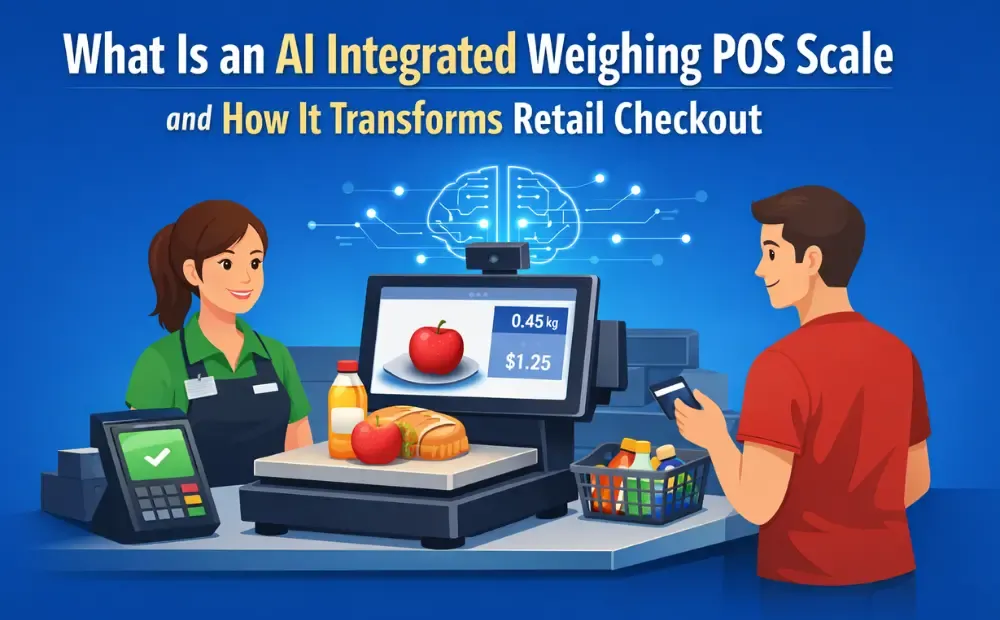
The conversation around AI and its use in business is not new. AI has been present for many years now, continually improving, learning, and becoming increasingly integrated into everyday operations, and it’s here to stay. Like every other industry, retail has its greatest impact at points where human effort is prone to error, such as the checkout counter, under constant pressure to move faster.
No matter what a customer buys, everything eventually funnels towards checkout. And in busy stores with high foot traffic, customers get frustrated with long queues because who doesn’t just want to be done and out the door. AI integrated weighing POS scales are made to improve the efficiency of checkout. In this article, you’ll learn what an AI integrated weighing POS scale is and how it affects the retail checkout experience from the ground up.
What Is an AI Integrated Weighing POS Scale?
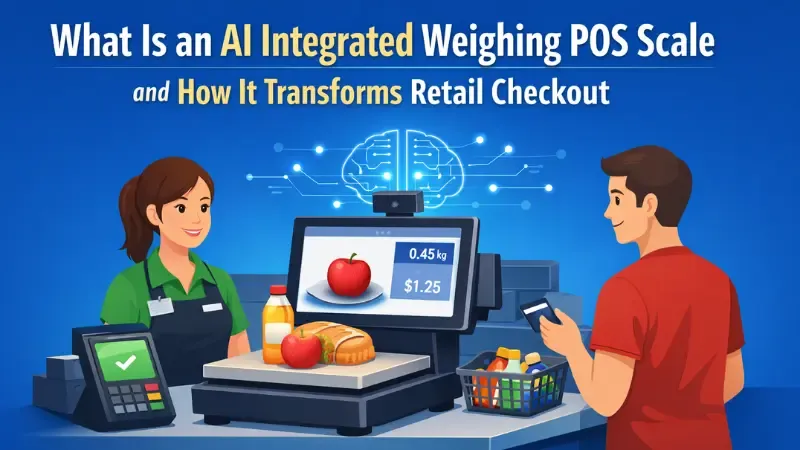
An AI integrated weighing POS scale is a smart checkout device for the following three retail actions merged in one workflow:
- Computer-vision–based product recognition
- Weighing a product
- Charging for the product
In short, when someone places an item on the scale, the scale automatically identifies the type and weight of the item, and then matches the item with the correct SKU/PLU code in the database. The item price is calculated in real time and then sent to the POS system for payment and receipt generation.
You’ll hear several related terms in the POS industry.
An AI POS scale is the general label for a scale at the checkout counter that has been upgraded with AI vision. It processes transections as part of the POS.
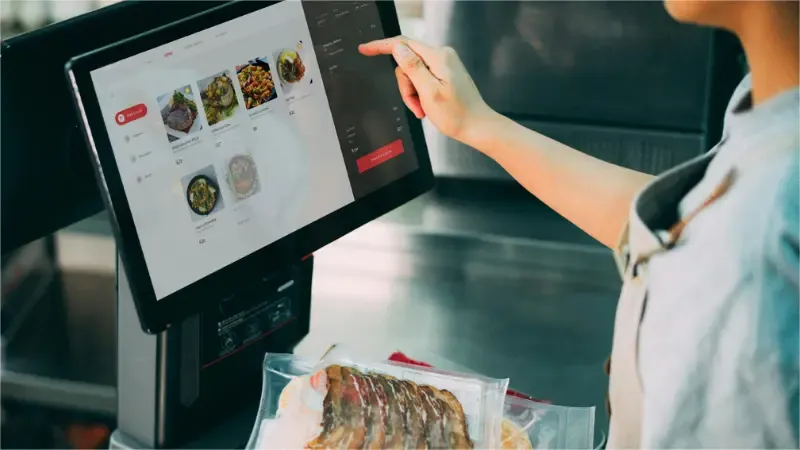
The AI Weighing POS Terminal is more integrated. Besides being a POS terminal, it has a built-in weighing platform and an AI camera to run a full checkout interface with payment controls.
Meanwhile, an AI-Enabled Checkout Scale is more of a smart peripheral. It just feeds AI-identified weight and product data into a POS you have in use already. It, essentially, is a component of semi-automated or hybrid checkout terminals.
How Does an AI Weighing POS Terminal Work?
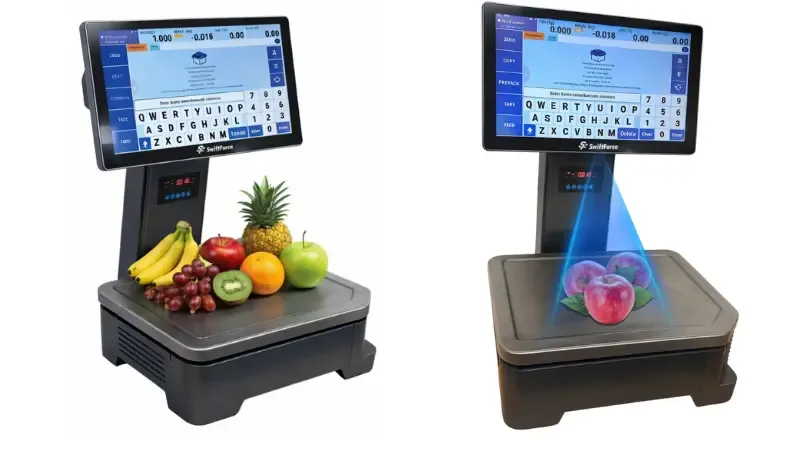
It’s simple physics. Each of the three steps is built upon technology that has been around for years, just used innovatively.
AI Product Recognition Explained
The product recognition system runs in the same way facial recognition in your phone works. Or, how medical imaging is recognized.
A camera within the scale captures images of an object once it is placed on the POS. And within fractions of a second, the images are converted into patterns of edges, colors, textures, contours, and spatial relationships for AI-based analysis.
The AI, as you’d expect, is trained on millions of labeled product images so it knows how to distinguish one SKU from another, despite them looking frustratingly similar to the human eye. (Green apples versus Granny Smiths, for example!)
Smart Weighing + POS Integration
The weighing technology uses high-precision load cells. There’s some physics involved here. The load cells detect changes in pressure on the POS as an item is placed on it, and the physical force is converted into electrical signals until a stable weight plateau is reached.
AI Weighing POS terminals are smart enough to eliminate the forces from uneven product placement and user movements.
The terminal also sends signals to the central POS system so that an update in the inventory levels can be made. All sales data is also recorded for analytics.
AI-Enabled Checkout Scale in Real-Time Checkout
The third component of the AI-integrated weighing POS scale is the accurate calculation of pricing.
After it has estimated the weight of the product, the POS applies either a price-per-unit or price-per-weight calculation system for total payments. If any loyalty discounts or promotions are available, they are auto-applied too.
The prime benefit of real-time checkout is that it happens in one continuous move. There’s no cognitive load on the salesmen to remember codes and no disruption in the efficiency of the workflow looking into how they could log in the sales of unbarcoded goods.
Why Retailers Are Upgrading to Smart Weighing POS Systems
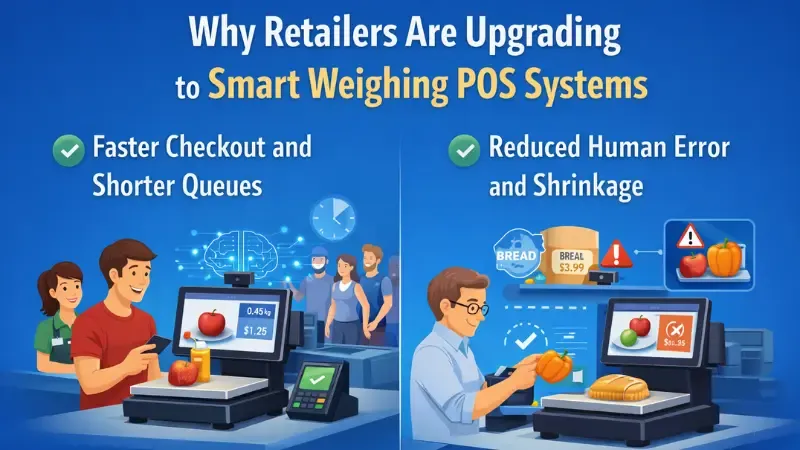
Primarily, two reasons:
- Speed
- Accuracy
Faster Checkout and Shorter Queues
People hate waiting. E-marketer reports that over 60% of customers get irritated by long checkout lines.
Psychologically speaking, when a customer turns into the last aisle, their brain starts considering that they’re almost done with their shopping journey, and their mental energy naturally shifts to the next task. The checkout counter is just something they need to get through as fast as possible.
Smart weighing POS systems have a huge impact on perceived speed. Traditionally, checkout for fresh or bulk items in particular required the cashiers to manually count/weigh the product, remember PLU codes, scroll through menus and whatnot before they made a receipt.
AI removes all of these micro-frictions entirely, so it improves the customer’s checkout experience. All a customer does is place the item down, let the system recognize it, weigh it, price it, and move on. It aligns with the customer’s mental state, i.e., I’m done, let me leave!
Reduced Human Error and Shrinkage
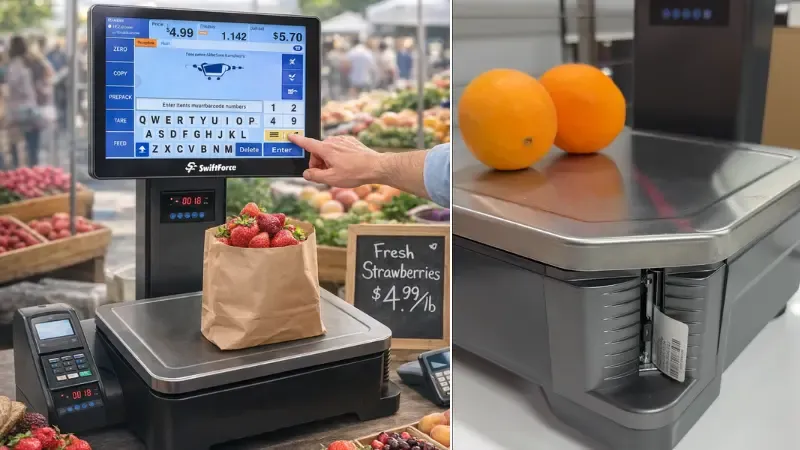
Error reduction is another big reason why retailers are snapping up smart POS scales.
It is no surprise that manual PLU is quite fragile. An overworked cashier can very easily miss the distinction between two similar products or misread a decimal point when calculating prices. The impact of such errors is straight cost leakage!
AI weighing scales are trained to cross-validate the image they capture with an expected weight range it should fall within. A pair of apples shouldn’t be weighing close to a watermelon, right? Such auto-checks reduce the chances of errors a human would otherwise make dozens of times a day.
The AI will never get tired after lunch. It won’t read a 7 for a 1. It won’t get distracted by a phone call or a conversation. Some estimates say that the human eye is only 70% accurate at image recognition, but there are AI systems in the market that offer up to 97% accuracy at the same.
You’re basically guaranteed accuracy in an AI-integrated checkout workflow, which ultimately prevents cost leakage.
AI POS Scale for Supermarkets and Fresh Food Retail
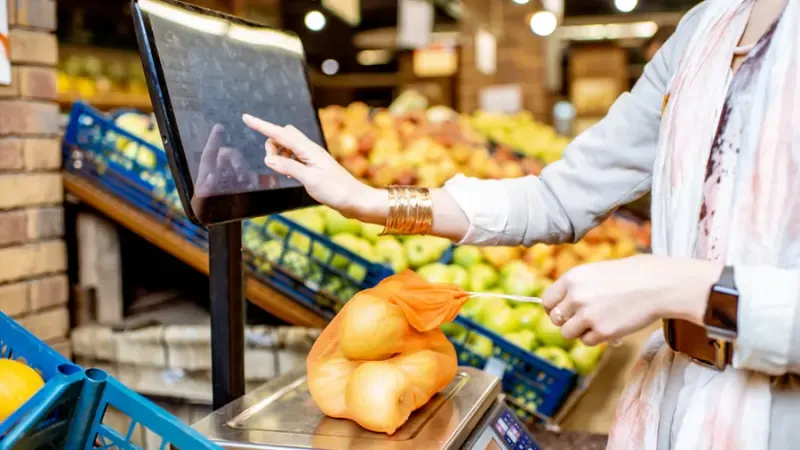
The AI POS scales fit most naturally in places with the clunkiest checkouts, i.e., items with no pre-labelled barcode, and products with varying shapes and sizes, like fruits and vegetables.
Fresh food is messy by nature. It is almost impossible for all apples to look and weigh the same. Produce aisles are notorious for PLU confusion simply because there are so many variations within the same product line. Organic versus conventional, similar-looking varieties, seasonal changes, it is not easy to remember all of these.
Similarly, freshly baked goods (croissants, rolls, muffins, breads) are almost never uniform. Stores with in-house baking or self-serve pastry areas are great places for AI weighing POS integration.
Perhaps the best use case for AI POS systems is in supermarkets. Manual checkout counters are way too inefficient for high-volume spaces.
Even if you save just a few seconds through the AI POS scale for supermarkets at every customer’s checkout, you end up with a much higher cumulative checkout capacity without adding any extra lanes.
Of course, all supermarts need that efficiency, particularly during evening rushes and weekend peaks.
AI POS Scale vs Traditional Weighing Scale
Here’s a quick table that shows the differences between the AI POS scale vs traditional scale:
| Aspect | Traditional Weighing Scale | AI POS Scale |
|---|---|---|
| Product identification | Manual PLU entry or menu search | Automatic AI vision recognition |
| Role of the system | Standalone weighing device | Fully POS-integrated checkout terminal |
| Checkout speed | Slower being human-dependent | Faster |
| Error rate | Higher (wrong PLUs, mislabeling) | Significantly reduced |
| Staff training requirement | Recurrent, so high | Low |
| Peak-hour performance | Degrades under pressure | Stable |
| Long-term ROI | Cheap upfront with ongoing costs | Big initial investment with compounding operational savings |
Functional Differences
A traditional weighing scale is fundamentally reactive.
All it does is weigh what is placed on it, but a cashier must look at the item to identify it by either entering a PLU code from memory or scrolling through the menu. Only then does the scale calculate a price. In itself, the standalone scale has no understanding of the product.
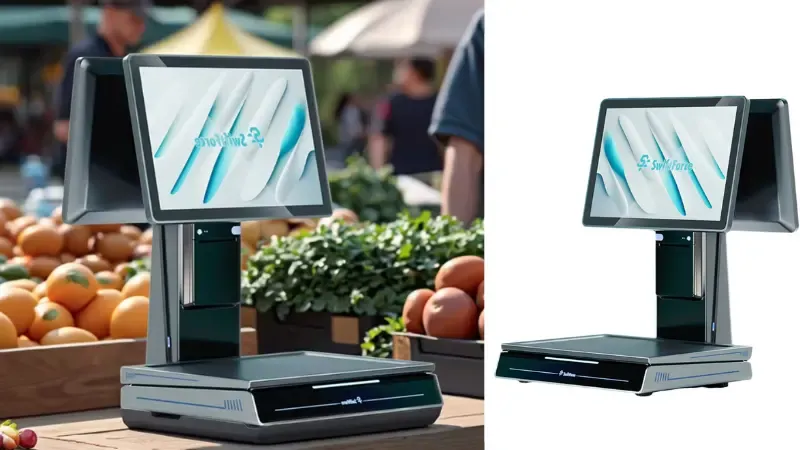
Compare that with an AI weighing POS scale that captures visual data and analyzes it through shape, color, size, texture, etc to auto-identify the product. It is a POS-connected, intelligence-driven terminal with active participation in checkout logic, inventory updates, pricing rules, and transaction flow.
Accuracy, Speed, and Labor Cost Comparison
As we discussed earlier, traditional scales are limited by human behavior.
If a cashier runs through an unfamiliar product, or they get tired due to peak-hour stress, chances are high that they’ll mess up. The same reasons also cause scrolling, correcting, and re-entering info, leading to higher checkout processing times.
Manual staff training is inherently prone to mistakes. We can’t really expect a human to accurately be aware of every single PLU code, learn category hierarchies, or stay updated with every change in assortment.
In an ideal case scenario, they should. But is it realistically possible for everyone?
AI integrated POS systems take care of all three issues here: speed, accuracy, and training. The operating staff should just understand the workflow, and all cognitively draining tasks are outsourced to AI.
Long-Term ROI for Retailers
Of course, traditional scales are much cheaper upfront if you compare one with a full AI-integrated POS weighing system. But we need to understand the long-term cost implications here.
There’s quite a lot of cost leakage in traditional systems, like we discussed above.
- Slow checkout counters led to a reduced number of customers being attended to at the same time compared to a faster checkout channel.
- Misreading or mislabeling products can cause substantial changes in your total revenue.
- You need to constantly invest in staff training.
And there are many more.
AI POS scales prevent all of these leaks. The ROI in the long-run is naturally higher!
Key Features to Look for in an AI Integrated Weighing POS Scale
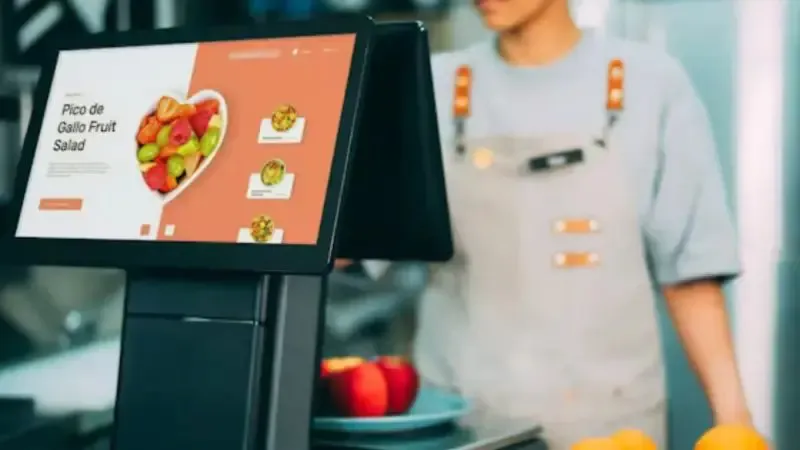
Broadly speaking, there are two components to an AI product recognition weighing scale. The hardware and the software.
The hardware is visible to you upfront, and naturally, it is a major deciding factor for many retailers. When you see how sleek a screen looks, you immediately think of your checkout counters and how it’ll look within your ecosystem.
And since these devices will be present at the most chaotic point in retail, the software must be accurate and reliable enough to keep up with the chaos.
Here are the top 5 features I’d look for if I were selecting an AI-integrated POS scale:
- The accuracy of AI image recognition in real retail conditions
- POS system compatibility (You need the pricing, inventory, promotions, and reporting to flow without constant manual intervention)
- An Intuitive UI design optimized for speed
- A high-quality camera that has on-device or edge processing
- Software update mechanisms so that it can keep improving with advances in AI
Is an AI-Enabled Checkout Scale Worth the Investment?
The sticker price of an AI POS scale is much higher than that of a traditional weighing scale. But to actually assess if it is worth the investment, we must take into account what it replaces in hidden costs.
Cost vs Value Analysis
On the cost side, a traditional scale is cheaper to install and maintain. It has fewer moving parts and fewer software dependencies too.
It is great if your store barely sells loose produce, or if you have experienced staff on board who never rotate and never make mistakes (it’s not most of the stories, that’s the whole problem).
An AI-enabled checkout scale naturally costs more because it’s a sensor stack with a computer plus software, including camera, processor, model updates, POS integration, a better UI, etc.
If we talk about value, though, AI POS scales get you thousand tiny wins that add up.
You save up on labor and training costs. You can have more customers pass through the same checkout infrastructure because individual customer transactions take less time. You don’t have unnecessary costs attributed to pricing errors anymore.
In the long-run, these savings are compounding. Saving a few seconds per transaction is not a very big deal until it is multiplied by thousands of weighable items per week. Then you have hundreds, thousands, even millions in savings.
FAQs
What is an AI POS scale?
An AI POS scale is a smart checkout device. It identifies weighable products using AI vision, measures their weight, calculates the price in real time, and sends the data to the POS system.
How accurate is AI product recognition for weighing?
AI product recognition is much more accurate than manual recognition. Many retail weighing POS scales offer image recognition accuracy in the 94–99% range.
Can AI weighing POS scales replace cashiers?
No. AI weighing POS scales do not replace cashiers. They just eliminate manual tasks like PLU entry and item lookup, so your staff can work at a faster speed.
Are AI POS scales suitable for small supermarkets?
Yes. AI POS scales are suitable for small supermarkets if you can afford the initial cost. It will also help you grow into a bigger business.
How is an AI POS scale different from self-checkout?
An AI POS scale is for product identification and weighing unbarcoded items using AI vision, best used within staffed or hybrid lanes. A self-checkout, on the other hand, is a full customer-operated checkout flow.
Future of AI Weighing POS Systems in Smart Retail
AI weighing POS systems will not replace checkout as we know it. They should, however, dissolve the checkout process into the flow of shopping until it barely feels like a step at all.
We see POS systems changing from being isolated devices into intelligent nodes in a larger network. They continuously learn from transaction data, refine product recognition models, and reduce the need for manual retraining.
The industry is clearly moving toward semi-automated, hybrid retail environments. In these setups, AI weighing POS systems efficiently manage fresh and bulk items, while traditional counters continue handling packaged goods.
Forcing every store into a radical redesign is not sustainable. But we can aim for a slow transformation towards a more efficient system that also does not eliminate the human trust factor entirely.
Ready to plan your next step toward AI-assisted checkout?
At SwiftForce, we design flexible POS and self-service solutions that support AI-powered weighing, hybrid checkout models, and scalable retail growth—without forcing disruptive store redesigns.
Visit to speak with our team and discover how SwiftForce can help you implement a future-ready POS strategy tailored to your store layout, workflow, and growth goals.