Last week, I attended a seminar on changing consumer behaviors and expectations, and one statement really caught my attention. “More and more shoppers are preferring a smart cart over a traditional one.”
At first, it sounded surprising. But thinking about it, it makes perfect sense. Customers love technology that makes their lives easier. In fact, studies show that 80% of consumers believe technology improves their shopping experience.
Right now, smart shopping carts aren’t as common as POS systems, but they are gaining traction. Big retail names like Amazon and Geissler have already embraced them for years. It’s now time for you to upgrade (before others beat you to it)!
What Are AI Smart Shopping Carts?
An AI smart shopping cart is a regular shopping cart, but with a brain of its own. It has fancy features like AI, sensors, and cameras that help it recognize the items customers put inside.
These carts automatically calculate your total and can even handle payment without going to a checkout line.
Sometimes called smart grocery carts, these carts not only scan items. They can track what is in your cart in real time, help customers stay on budget, and find products faster. Some even suggest deals or help locate items in the store.
AI smart shopping carts make shopping faster, easier, and less stressful. It gives customers a smooth experience from the moment they pick up your cart to the moment they leave the store.
And no, they are not all about benefitting the customer. Retailers, too, bask in the advantages of an AI smart grocery cart (more on that later).
How Do AI Smart Grocery Carts Work?
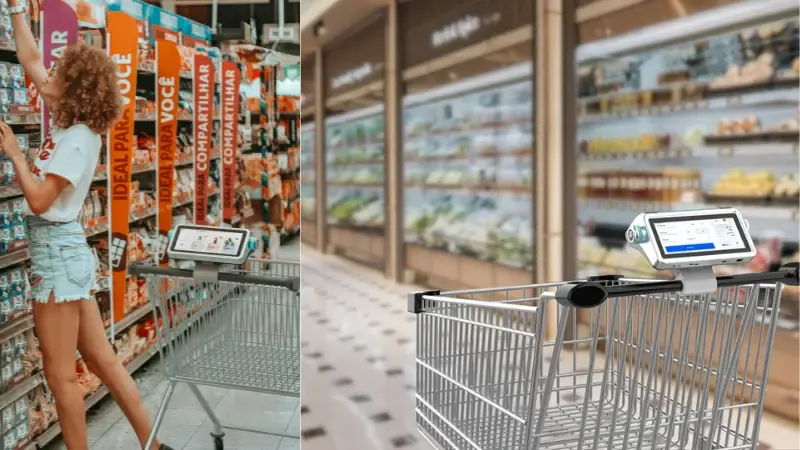
AI smart grocery trolleys use advanced technology to make shopping smoother and faster. But how do they do that?
Two things: AI and computer vision.
The cart has built-in cameras and sensors. As soon as a customer places a product inside, the cart scans and recognizes it.
These smart carts don’t need barcodes to scan an item. They identify it by its size, shape, and packaging.
The total on the screen keeps changing as the customer adds more items. The item tracking and real-time pricing feature allows customers to keep track of their spending. The system updates automatically even if a shopper replaces or removes an item.
Payment processing is also more convenient with AI-powered shopping carts. Most of them already have payment system integrations, so customers don’t have to wait in the checkout line. They can just pay through a card or mobile wallet at the cart.
The Benefits of AI Smart Grocery Trolleys for Retailers
AI smart grocery trolleys do good for retailers in ways you may not even expect.

Improved Efficiency
Smart carts make shopping and checkout faster. They automatically recognize items and handle payments, so customers don’t have to wait in line.
This also reduces the need for more cashiers. Instead of standing at the counter, your staff could restock shelves or help shoppers.
Enhanced Customer Experience
Smart carts make shopping easier. Shoppers can see how much they’ve spent, quickly find what they need, and walk out without waiting at the checkout.
The seamless experience improves satisfaction. And when customers leave satisfied, they are bound to return. This builds loyalty over time.
Data Insights
These carts give useful insights into customer habits. Retailers can see which products sell together, which are popular, and how people move around the store. This helps with stock, promotions, and store layout.
Reduced Shrinkage and Errors
A report shows US retailers lose 1.3% of daily sales due to inventory shrink and human error. AI smart grocery trolleys help reduce mistakes, prevent theft, and track items in real time for better store security.
Personalized Promotions and Marketing
Some smart carts can suggest deals or show promotions based on what shoppers buy. This helps increase sales and makes marketing more relevant to each customer.
Top AI Smart Shopping Cart Solutions in the Market
The market isn’t exactly saturated with smart shopping cart vendors, which is a good thing. It means narrowing down your best options is simple.
1. SwiftForce
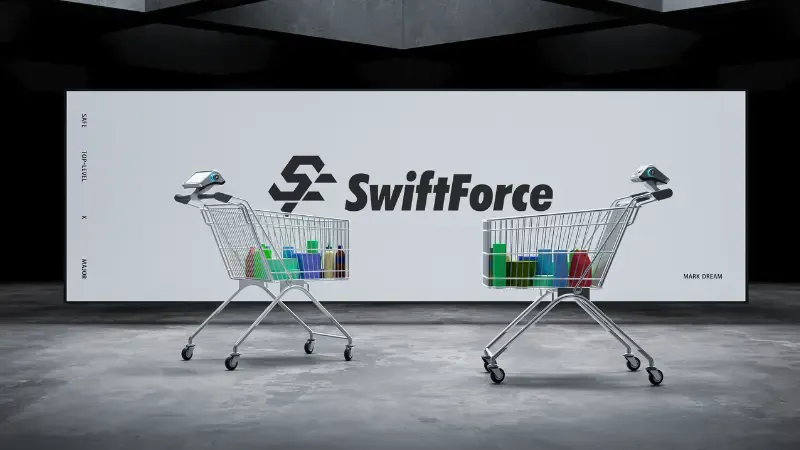
SwiftForce offers smart cart hardware solutions that support smooth checkout and real‑time analytics. These solutions are built particularly for supermarkets, hypermarkets, and convenience chains.
The best thing about SwiftForce’s smart cart hardware is that it easily connects with all existing inventory management and POS systems.
It’s also a better, lower‑cost alternative for retailers that want AI smart grocery trolley adoption without the full AI/vision sophistication of Caper.
2. Caper
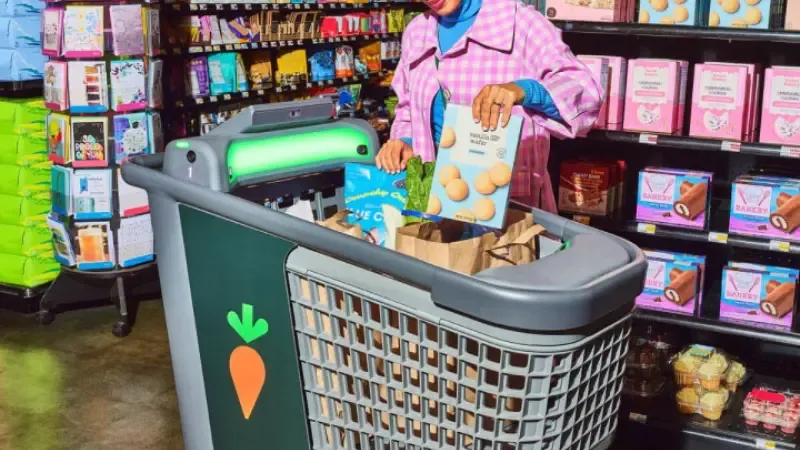
Caper offers an “automated grocery cart” designed to deliver a smart shopping experience inside the store. The cart uses AI, computer vision, and weight sensors to recognize items when placed in the basket.
It shows a running total on the cart screen, lets the shopper pay directly on the cart and leaves the store. The cart also integrates with loyalty programmes, coupons, and personalized offers via the screen.
It is built to work with existing POS/inventory systems, so adopting it isn’t that complicated.
However, Caper’s upfront cost is quite significant. An automated grocery cart can cost around $5000 to $15000 per unit. It has some amazing features, but again, not every retailer needs the most advanced solutions.
3. Standard Cognition
Standard Cognition offers a different type of solution. Rather than focusing on the cart itself, it uses AI and ceiling‑mounted cameras plus other sensors so that shoppers can pick items and simply walk out. The system handles checkout automatically.
This offers an added benefit of minimal hardware on carts. Plus, it works with any store layout and doesn’t require the shopper to scan each item.
The only problem with Standard Cognition is that you’ll have to make some major infrastructure changes to your store to implement this system. To make this work, you’ll need ceiling cameras, sensors, and back-end integration.
4. Zebra Technologies
Zebra Technologies is not primarily a “smart cart” manufacturer in the same sense as Caper, but it does provide infrastructure and devices that support a smart, automated shopping environment.
Their products and services help integrate carts, checkout systems, inventory, and data analytics to support a smart shopping experience. Mind you, this isn’t a plug‑and‑play “smart cart” product like Caper. It is more part of an overall solution.
The Future of AI Smart Carts in Retail
Smart cart technology has changed a lot already, but this is just the beginning. In the next few years, our retail shopping experiences will be completely transformed.

Next-Generation Features
Imagine what it would be like to pick up a cart that already knows what you like to buy. Future smart carts will use advanced machine learning to learn from your past purchases, suggest your favourite brands, and even remind you if you forget something you usually buy.
They will have RFID tags and better computer vision that will help them instantly recognize what you place inside without scanning.
And since everything will be cloud-connected, prices, promotions, and stock availability will update in real time. You could even get an alert on your cart screen if an item you often buy goes on sale.
Fully Autonomous Shopping
Full automation could be the next big leap for sure. I’m talking about walking into a store, shopping, and leaving (minus the lines, waiting, and small talk with cashiers).
The carts will track what customers pick almost instantly and use the shopper’s digital wallet to process payment. It will look a lot like online shopping with a bonus of browsing and a touch experience.
If this works out, retail owners can also set up fewer checkout stations at their stores. This would automatically increase the open floor space and create a more efficient environment.
Expansion Beyond Grocery
Smart cart technology is not stopping at supermarkets. In the next few years, you could be walking into a clothing store where your cart suggests a matching jacket for the jeans you just added.
The cart screen at an electronics store could help you compare different phone models side by side.
Hardware and furniture stores could also benefit from smart carts since they can guide customers through the aisles and show assembly videos.
As you can see, we are already in the automation phase. The next phase is about personal connection. About knowing the product AND the shopper.
Challenges and Considerations with Implementing Smart Carts

Smart carts for grocery stores promise quite exciting stuff (admit it!).
However, I won’t say the road to full adoption is as smooth as butter, at least not yet.
Technical Challenges
Smart carts solely depend on advanced cameras, systems, and sensors. These components need to be communicating in real time ALL THE TIME.
This could be a problem in stores with inconsistent Wi-Fi connections because you can’t guarantee connectivity 24/7. A minor network drop could cause the system to miss an item.
Accuracy is another big issue. It can be tricky to ensure the cart correctly identifies every product. Some products even have similar packaging, which could overcomplicate the process.
These issues, although major, are treatable. But they come at a cost. Regular software updates, recalibration, and staff training are only a few essentials you’ll need to make the system run smoothly.
I feel like that would just add another ongoing maintenance layer that most retailers tend to run away from.
Costs of Implementation
AI-powered smart carts for grocery stores can have a significant upfront cost. A single unit is usually priced at thousands of dollars, and I’m not even factoring in the infrastructure upgrades, software licenses, and support teams required to run them.
For smaller retailers, this can be a big barrier. It all comes down to the ROI in the end. How long will it take before the savings from reduced checkout staff and improved efficiency outweigh the upfront cost?
Larger retail chains may absorb the expense easily, but smaller stores will have to test the waters.
Customer Adoption
It doesn’t matter how smart your cart is if your shoppers aren’t comfortable with it. Most senior citizens find the idea of scanning and tapping a bit intimidating.
Some customers also prefer human interaction over dealing with an AI system.
Smart cart adoption is, therefore, a gradual process. You will have to put up clear signage and offer friendly assistance until your customers are comfortable using the system.
Security and Privacy Concerns
Data is yet another concern. Smart carts collect information about a customer’s shopping habits, movement through the store, and purchasing patterns.
While it does not exactly fall under the ‘sensitive’ information category, retailers still have to be cautious. They must handle this responsibly and discreetly to guarantee data protection.
A single security breach could undo months of goodwill.
Frequently Asked Questions
What is a smart shopping cart?
A smart shopping cart uses AI, sensors, and cameras to identify products, track spending, and let shoppers pay directly without waiting at checkout counters.
What are the advantages of smart shopping trolleys in retail?
Smart carts can speed up checkout, cut labour costs, improve inventory tracking, and enhance customer experience.
How do AI smart grocery carts work?
They use computer vision and sensors to recognize items, calculate totals in real time, and process payments automatically through an integrated system.
Conclusion
It doesn’t take a genius to figure out how AI has changed how we move, work, shop, and think. It has given convenience a completely new name. And the same holds true for smart cart technology.
However, the real question isn’t if this technology will take over; it’s who will lead the way. Retailers that act early will gain efficiency, loyalty, data, and a forward-thinking brand image.
If your goal is to deliver a faster, smarter, and future-ready shopping experience, the path forward is already clear.
Ready to take your first step toward intelligent retail?
SwiftForce helps retailers adopt smart cart technology with reliable hardware, expert guidance, and flexible integration support.
Talk to us today and let us be there for your first step towards a smart shopping experience.